Product detail
What it
looks like
in operation.
Real screenshots from the running system. Every screen is what the MLRO actually sees when an SXM client walks through the door — no marketing mockups.
01 · Dashboard
The operating picture
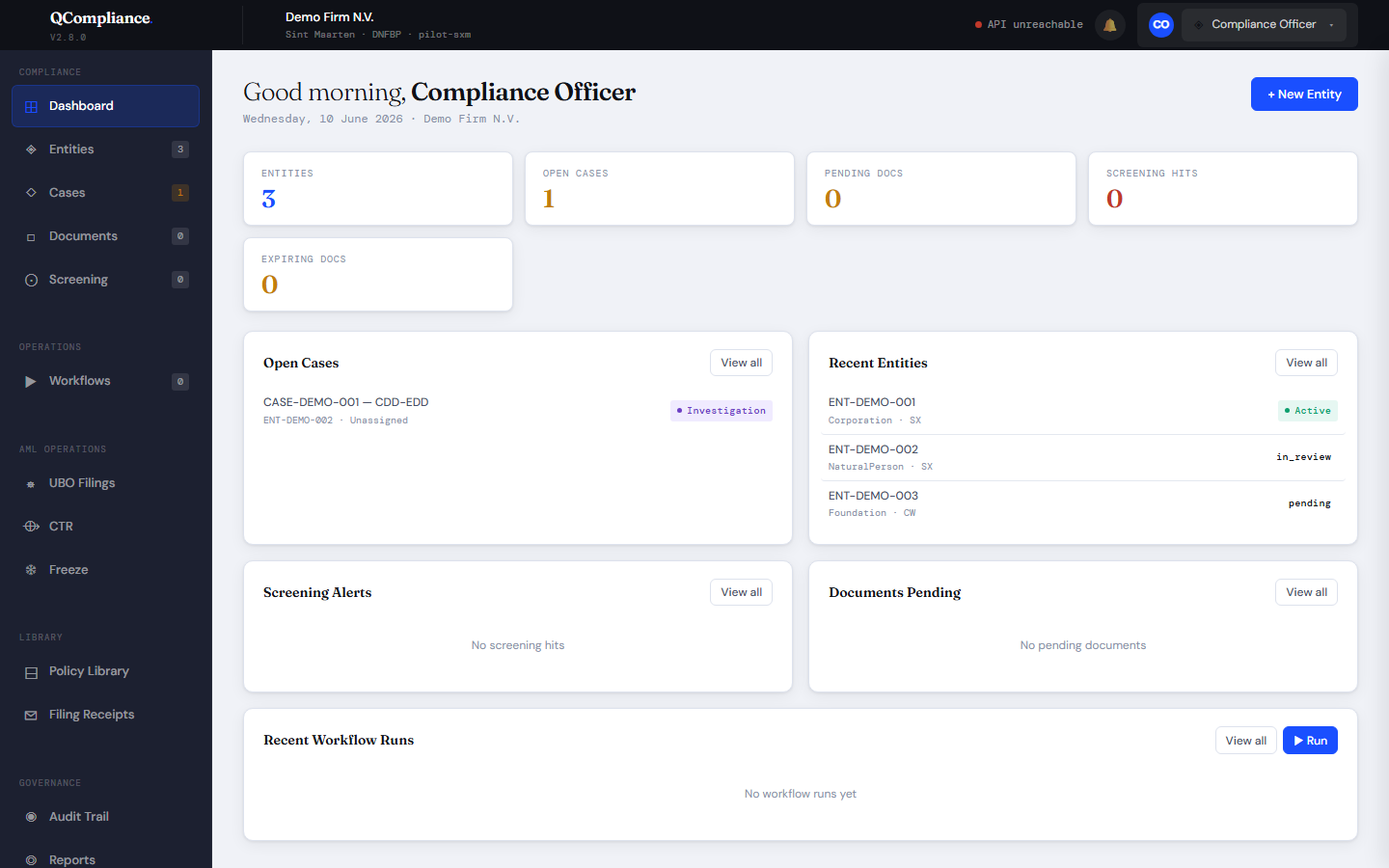
One screen tells the MLRO what's open, what's due, what's flagged. Tiles at the top, work queues below, no clicking required to know whether the firm is on top of its obligations today.
- Entities tile — total under management
- Open cases — investigations + EDD reviews in progress
- Pending docs — uploads awaiting verification
- Screening hits — sanctions / PEP matches needing decision
- Expiring docs — passports / IDs approaching expiry
- Recent entities + open cases + screening alerts + workflow runs — always one click from the queue
02 · Entities
Every client, every status
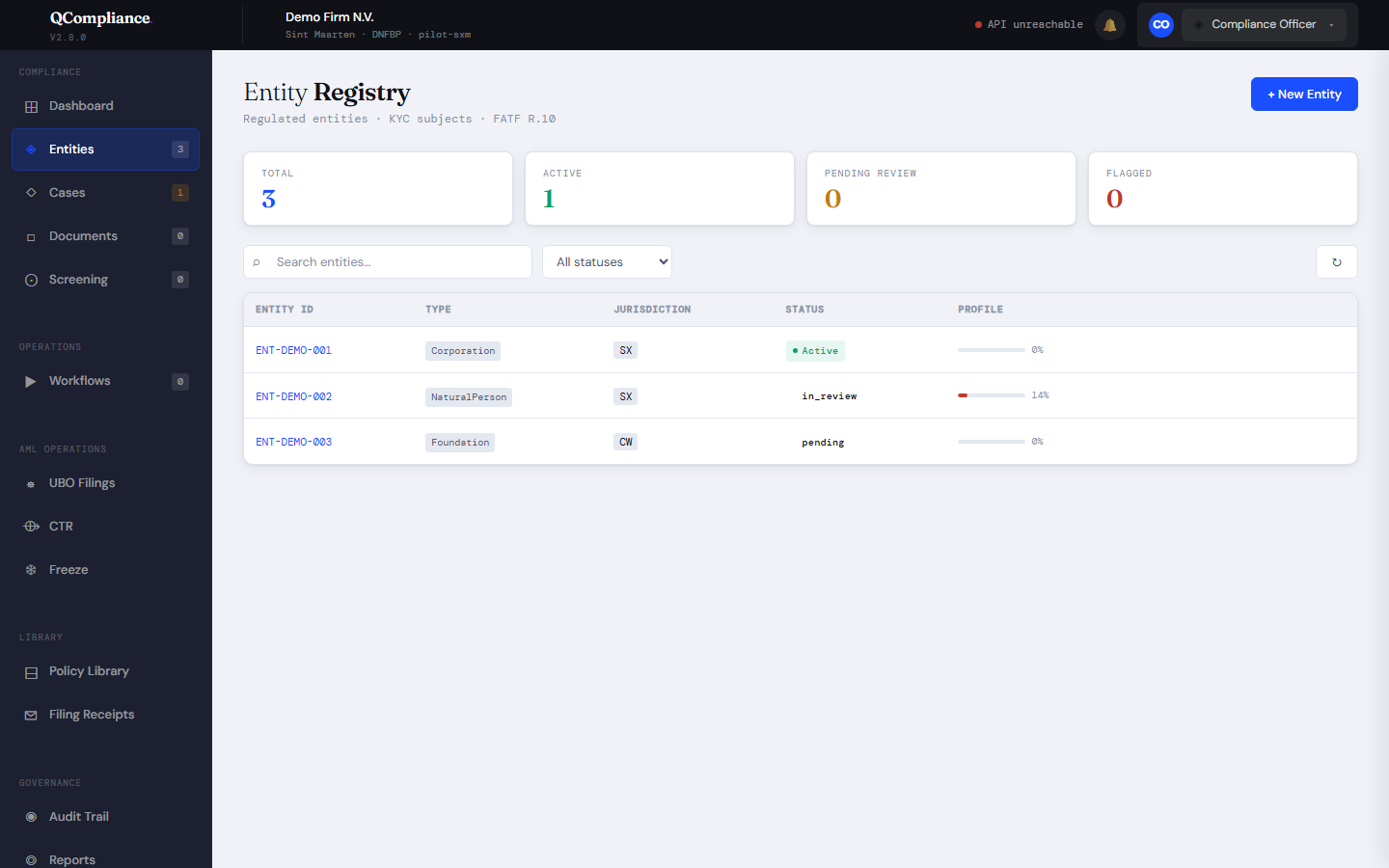
The entity register is the spine of the system. Natural persons, corporations, foundations, trusts, partnerships, VASPs, DNFBPs — same record shape, different field sets under the hood.
- Entity type (NaturalPerson, Corporation, Foundation, Cooperative, Trust, VASP, DNFBP, FinancialInstitution, etc.)
- Jurisdiction (SX, CW, AW, BES, NL, EU, other)
- Status (active / in_review / pending / suspended / closed)
- Risk classification + last-review-date + next-review-date
- Click any row → side panel with full entity detail + 5 action buttons
03 · Entity detail panel
One click to everything about a client
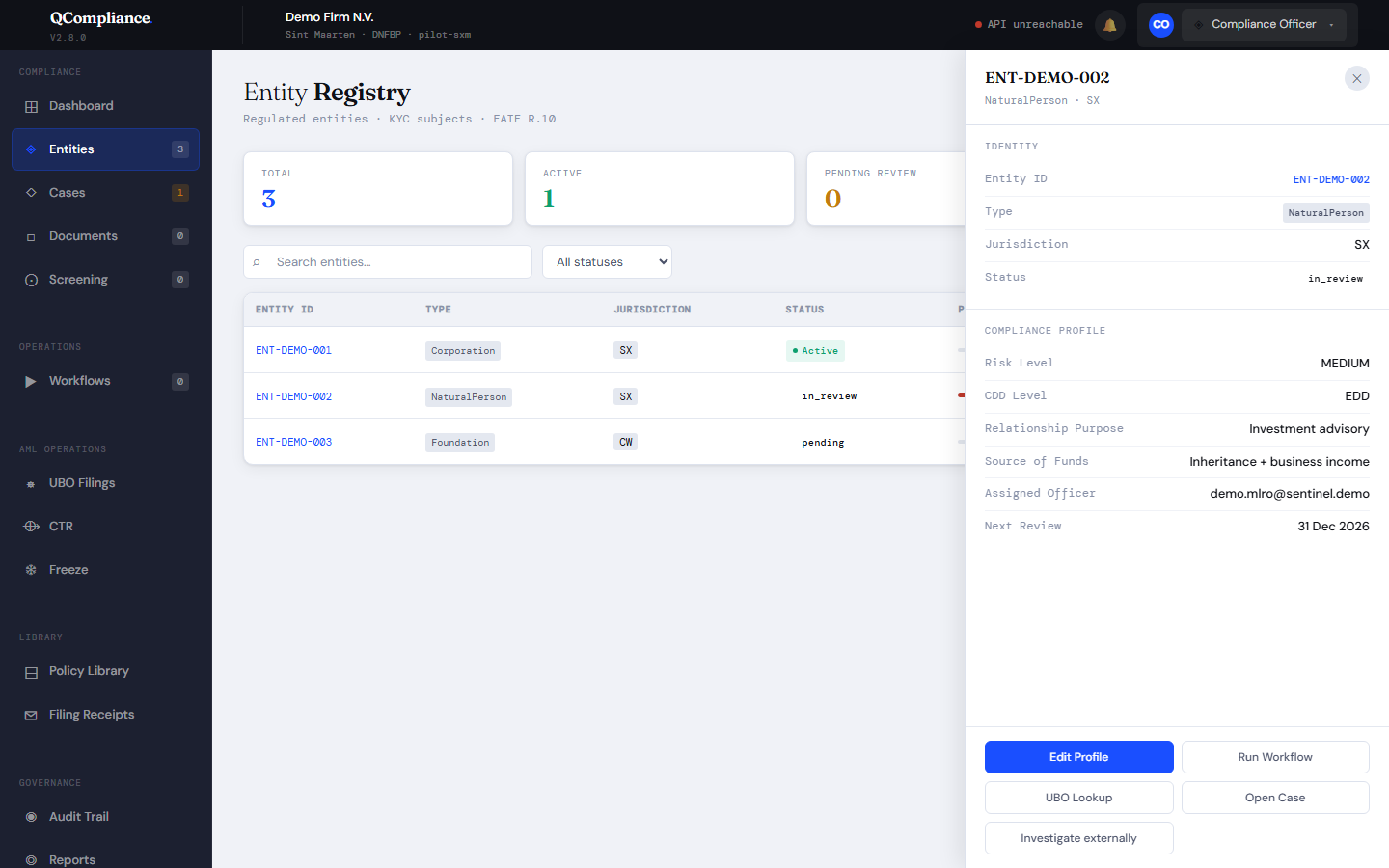
Side-panel opens with identity + compliance profile + the five next-actions an MLRO needs most. No deep navigation. No "open this in a new tab to see the rest."
- Identity: entity ID, type, jurisdiction, status
- Compliance profile: risk level, CDD level, relationship purpose, source of funds, assigned officer, next review date
- Actions: Edit Profile · Run Workflow · UBO Lookup · Open Case · Investigate externally
04 · Investigate externally
Eight free tools, one click away
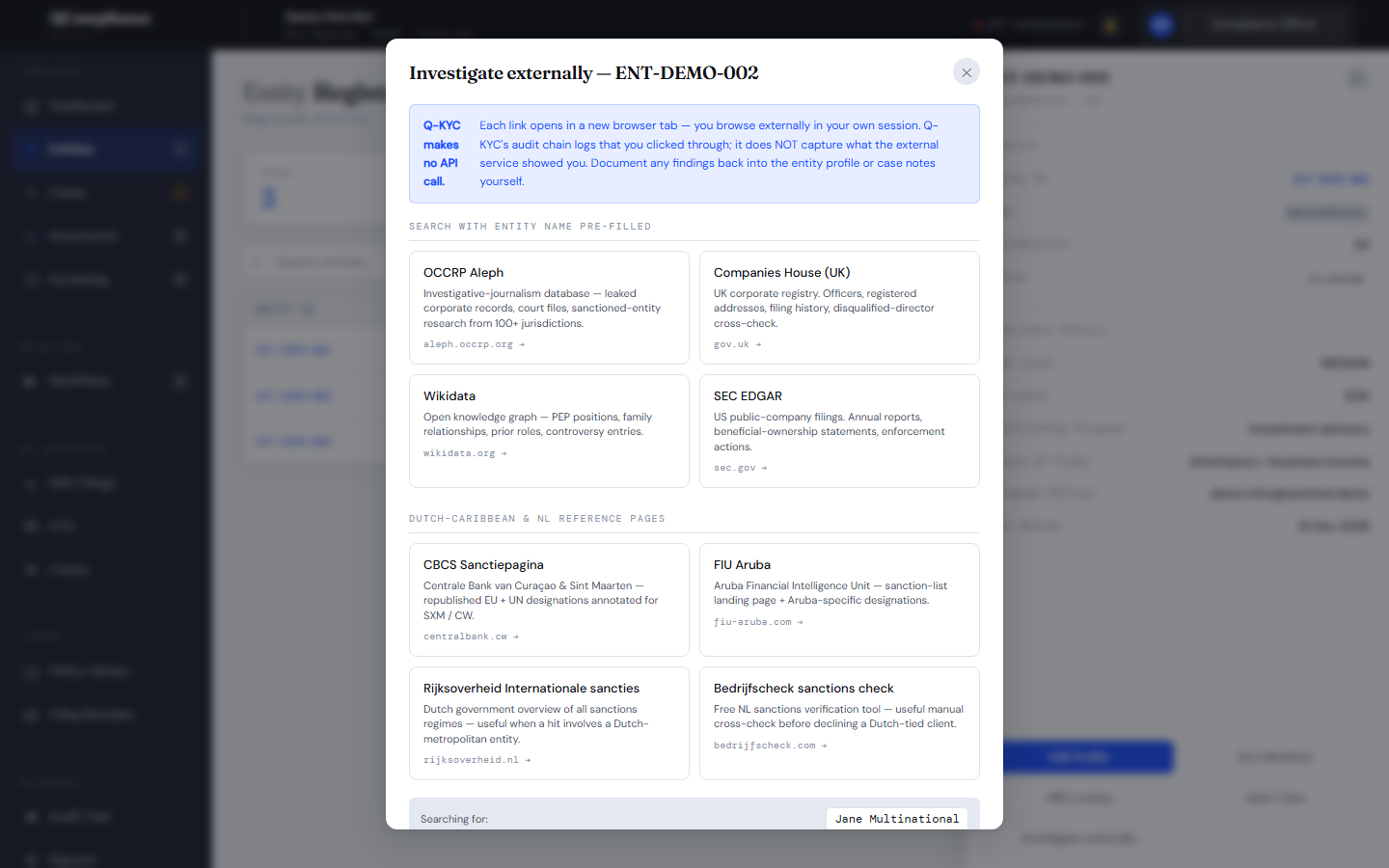
When you need to dig deeper, Q-KYC opens the public investigation tools you'd use anyway — pre-filled with the entity name. Q-KYC makes no API call; the operator browses in a new tab, in their own session.
- Search with entity name pre-filled: OCCRP Aleph, Companies House UK, Wikidata, SEC EDGAR
- Dutch-Caribbean & NL refs: CBCS Sanctiepagina, FIU Aruba, Rijksoverheid Internationale sancties, Bedrijfscheck
- Q-KYC's audit chain records that you clicked through — never what you found externally
- Document your findings back into the entity notes or case file yourself
- Zero licensing risk: each tool is browsed manually in your own session
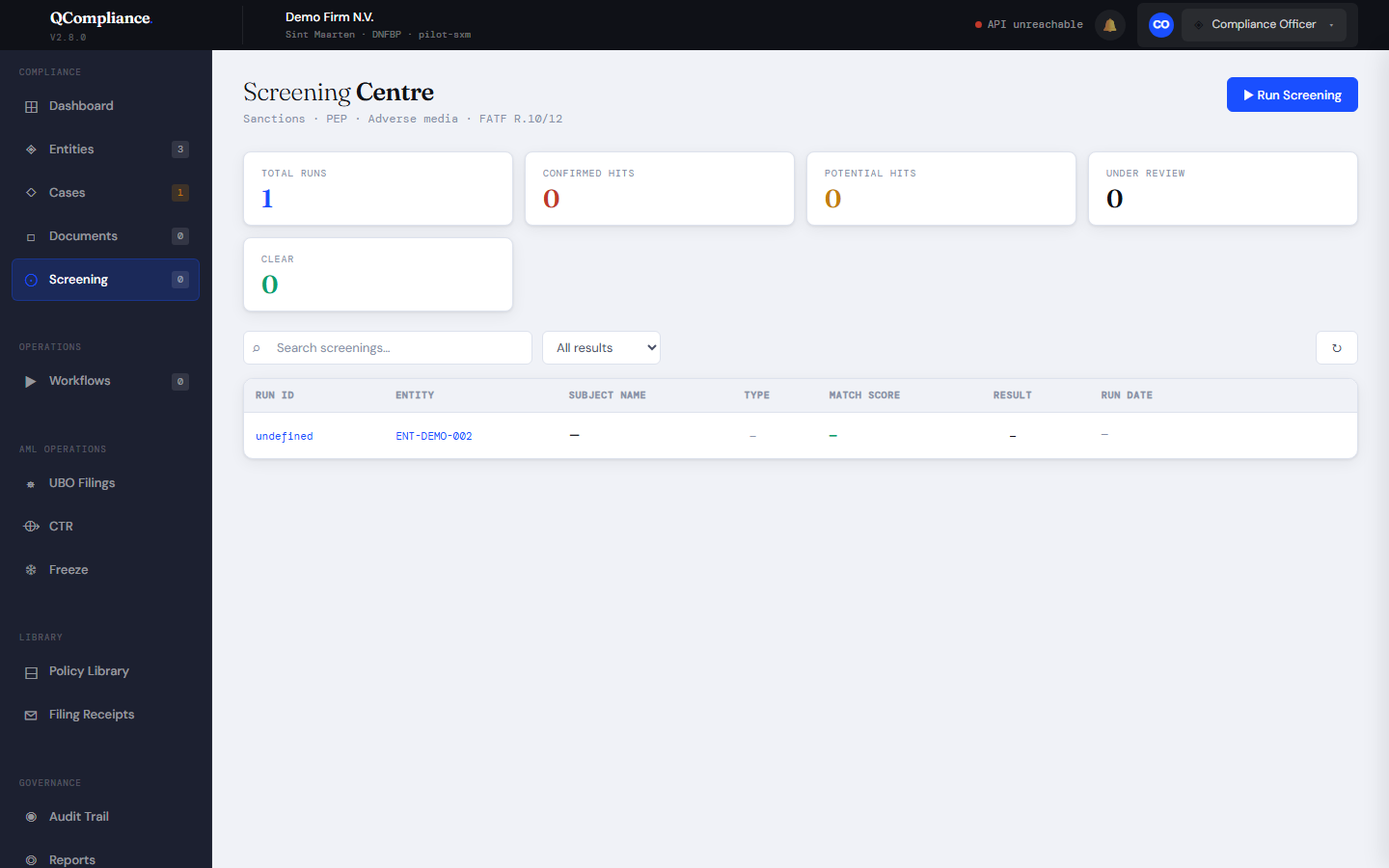
05 · Screening
345 sources, one query
Every entity gets screened against the full federation: OFAC SDN + Consolidated, UN, EU, UK HMT OFSI, Canada Justice, Switzerland SECO — pulled direct from each publisher daily. Plus OpenSanctions consolidated (336 additional source datasets globally, when you bring your subscription).
- Direct publisher feeds: 9 government sources, refreshed daily / weekly per source
- OpenSanctions DEFAULT: Australia DFAT, Japan METI, World Bank Debarred, Brazil PEPs, Russian + Ukrainian registers, India NSE, US SAM, plus 300+ more
- Fuzzy match across all of it in one query using token-set ratio at threshold 0.85
- Hit handling: operator reviews each match with full source provenance
- Source provenance per hit: source URL, publisher version date, SHA-256 of source bytes, fetch timestamp
06 · Hash-chained audit log
Regulator-grade defensibility
NOIS art. 33 requires CDD records to be retained for five years. The unwritten part: they need to be intact, not just present. Q-KYC writes every event into a SHA-256 hash-chained log — a CBCS supervisor can verify integrity with one command. Five-year retention is guaranteed by the chain math plus the customer's backup discipline (per the hardware spec).
- Hash formula:
sha256(prev_hash ‖ event_id ‖ actor ‖ event_type ‖ payload_json ‖ created_at_utc) - Genesis hash = 64 zeros; each row's
previous_hash= previous row'sevent_hash - Tampering with any historic row invalidates every row after it
- Off-box nightly backups each carry their own hash-state stamp
- Standalone
verify_audit_chain.ps1ships with every install — walks every event from genesis and reports any break with exact position - Print the verifier output for your external auditor or CBCS supervisor

07 · Statute alignment
Built from the
Landsverordeningen up
Global SaaS competitors are built around UK MLR + EU AMLD with Dutch Caribbean specificity bolted on. Q-KYC starts the other way round — every screen, every workflow, every report aligns to the statute text your supervisor cites.
- NOIS art. 11 — goAML 4.0 unusual-transaction + CTR drafts in FIU SXM's exact shape
- NOIS art. 23 — tip-off lock enforced in software, MLRO-role-gated release
- NOIS art. 33 — 5-year hash-stamped retention + standalone verifier
- LID art. 2-7 — 8-tab CDD wizard with mandatory-field gates
- Sanctielandsverordening — implemented via direct EU + UN pulls
- CBCS P&G §1-12 — FIU Template 2 risk engine + §11 annual report from the audit log
- LBP art. 14 — Fernet encryption at rest; on-premise; no cross-border transfer
- KvK SXM UBO — declarations in the Chamber's filing shape
NOIS
Melding Ongebruikelijke Transacties — art. 11, 23, 33
LID
Identificatie bij Dienstverlening — art. 2-7
Sanctielandsverordening
EU + UN sanctions implementation
CBCS P&G
Provisions & Guidelines on AML/CFT §1-12
LBP
Bescherming Persoonsgegevens — art. 6-14